
Growth at scale is rarely driven by a single breakthrough. It is built through thousands of decisions made early, inside factories, systems, and supply networks.
At HUL, the supply chain has long been treated as a strategic engine for the future. As demand patterns evolve, portfolios become more complex, and sustainability expectations sharpen, the investments we make in manufacturing capability increasingly determine how resilient, responsive, and competitive the business can be.
Over the past several years, we have been strengthening our supply chain through sustained investments in advanced manufacturing and digital capability. The latest recognition of additional HUL sites by the World Economic Forum’s Global Lighthouse Network reflects this direction. More importantly, it signals how we are reimagining manufacturing to support growth that is both durable and responsible.
Moving from efficiency to intelligence at scale
Incremental efficiency gains are no longer enough. To stay ahead, we are building factories that can sense, learn, and respond in real time.
By embedding AI, machine learning, industrial IoT, and digital twins into core operations, we are enabling our sites to anticipate constraints, optimise performance dynamically, and manage volatility with greater confidence. This matters in a context where innovation cycles are accelerating, product variants are increasing, and supply chains are exposed to climate, resource, and demand-related disruptions.
Two of our recently recognised sites, Gandhidham in Gujarat and Pondicherry in Tamil Nadu, illustrate how these investments translate into measurable business and sustainability outcomes when applied with focus and intent.
Gandhidham: Building resilience in a resource-constrained landscape
Our Gandhidham site operates in the water-scarce region of Kutch, where long-term success depends on disciplined resource stewardship and strong community integration.
Here, we undertook a transformation across two critical sustainability pillars: Nature and Climate. We applied AI, digital twins, and IIoT (Industrial Internet of Things) across the end-to-end supply chain to strengthen water stewardship, improve disruption management, and enhance traceability and sustainability across sourcing and formulations.
Digital tools enabled more precise water management and supported initiatives such as digitally enabled aquifer recharge, extending impact beyond the factory gates. Traceable palm oil sourcing, biodegradable formulations, and the use of climate-friendly refrigerants were integrated into everyday operations rather than treated as separate initiatives.
The outcomes reflect the scale of the shift. We reduced water use by 17% and saved 6.12 billion litres of water for the surrounding community. Waste was reduced by 48%. Scope 1 and 2 emissions fell by 90%, and contributed to a 12% reduction in Scope 3 emissions. These gains were delivered alongside 24% business growth, reinforcing the link between sustainability and performance.
Pondicherry: Unlocking growth through digital precision
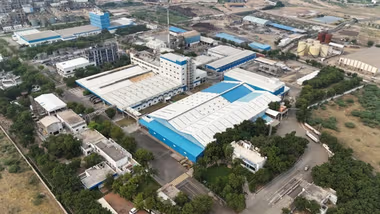
At our Pondicherry site, a strategic manufacturing hub in South India, the challenge was different. Rising demand and accelerating innovation cycles were driving greater product complexity and operational pressure.
To address constraints around throughput, quality, and flexibility, we deployed a suite of advanced digital solutions. These included machine learning-driven process control, AI-powered autonomous troubleshooting, and digital tools for changeover optimisation and manpower forecasting.
These capabilities allowed us to anticipate issues before they escalated, reduce downtime during changeovers, and operate with far greater precision across shifts and product runs. Flexibility became embedded in the system rather than managed through workarounds.
As a result, the site enabled 25% volume growth, reduced defects by 23%, and supported a threefold increase in product variants within existing production capacity.
Continuing to invest ahead of demand
Across our manufacturing network, a common philosophy guides these efforts.
Our supply chain strategy is shaped by three priorities:
- building resilience in the face of volatility,
- enabling faster and more flexible growth,
- and embedding sustainability into the core of how we operate.
Digital capability is a critical enabler, but its impact comes from how it is combined with deep process expertise, strong governance, and a long-term view of value creation.
Recognition through the Global Lighthouse Network is an important milestone for us. The larger story lies in how these capabilities are helping us shape a supply chain that can support HUL’s future, consistently, responsibly, and at scale.