
Our approach to sustainability is about delivering impact faster with more focused, urgent and systemic action across our big four sustainability priorities: Climate, Nature, Plastics and Livelihoods.
This page provides an overview of the actions we're taking on climate.
Driving widescale change
Driving widescale change
Unilever’s updated Climate Transition Action Plan (CTAP) focuses on ten action areas where we can best drive positive impact by 2030. Some of these are:
- Growing our Supplier Climate Programme to help key suppliers become climate leaders
- Investing in deforestation-free supply chains
- Reformulating products to use lower-emission ingredients without compromising performance
Alongside actions like these, we’re pushing hard for system-level change. Change that will address barriers to faster emissions reduction. The climate challenge is huge. And we’re facing it head-on.
Where climate meets science
Where climate meets science
Leveraging science and innovation, we are redesigning and reformulating products using newer technologies and multi‑benefit ingredients that deliver sustainability gains while providing superior performance and affordability, recognising that solutions must scale without compromising the consumer experience.
Suppliers Climate Program
Suppliers Climate Program
Transitioning away from fossil‑fuel‑based chemicals in our laundry and cleaning formulations is critical to achieving our net‑zero ambition. It’s our toughest challenge, and one we can overcome only through strong partnerships across the value chain.
Through our Supplier Climate Program, we work with suppliers to help reduce their emissions and, in turn, ours.
Partnership with Tuticorin Alkali Chemicals and Fertilisers Limited and Carbon Clean Solutions
Partnership with Tuticorin Alkali Chemicals and Fertilisers Limited and Carbon Clean Solutions
We have partnered with Tuticorin Alkali Chemicals and Fertilisers Limited and Carbon Clean Solutions, who use cutting‑edge carbon‑capture technology to capture CO₂ from their energy use and convert it into soda ash (sodium carbonate). This soda ash is a key ingredient in our detergent brands such as Rin, Wheel and Surf excel, and this partnership directly supports our ambition to reduce the carbon footprint of our detergent portfolio.
Material transition for chemical industry to achieve Net Zero: Collaboration with RECEIC
Material transition for chemical industry to achieve Net Zero: Collaboration with RECEIC
We are extending our impact beyond our value chain by enabling industry level action. Through our collaboration with the Resource Efficiency and Circular Economy Industry Coalition (RECEIC)—a G20 initiative of the Government of India—we are accelerating the materials transition in the chemicals sector from fossil based to biobased and renewable ingredients. We have published a knowledge paper outlining the opportunities and barriers, and identifying the critical technology, infrastructure, and policy interventions required to enable this transition at scale.
In collaboration with leading industry partners through RECEIC, we are building a lighthouse project to showcase how renewable ingredients can be scaled into viable chemicals for the Industry.
Pathbreaking resource-efficient innovation – Stratos
We are committed to advancing our sustainability agenda by integrating technologies that reduce both environmental impact and elevate product superiority. A prime example is Stratos, a breakthrough Low TFM (Total Fatty Matter) Soap Bar technology that delivers superior sensorial and skin benefits while lowering GHG emissions, enabling NDPE (No Deforestation, No Peat, and No Exploitation) compliant sourcing, and reducing reliance on imported oils.

Decarbonising our operations and value chain
We continue to take climate action across our operations with a focus on eliminating fossil fuels and switching to renewable energy.
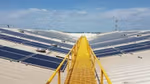
We are switching to renewable energy sources, such as wind, biomass, and solar energy. Implementing energy-efficient capital projects and infrastructural improvements have enabled us to reduce our energy consumption and eliminate the use of coal at all our manufacturing sites.
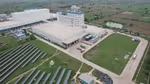
Indian Green Building Council certified
Our Sumerpur factory achieved IGBC’s (Indian Green Building Council) Platinum Certification for its outstanding green campus. The Pear’s Personal Wash and Blown plant of the campus have also been awarded the prestigious LEED Gold Certification by the U.S. Green Building Council (USGBC) reaffirming our commitment to world‑class sustainable manufacturing.
The Sumerpur site is carbon neutral. No water is wasted through effective harvesting, recycling, and reuse. It is entirely powered by solar energy and incorporates several eco-friendly innovations. Initiatives such as natural ventilation, use of energy-saving equipment, and extensive tree plantation, with thousands of trees planted, further emphasise our persistent commitment to sustainability.
Decarbonising our transportation and logistics
With structural changes in manufacturing and distribution networks, our ‘Load more, travel less’ strategy has enhanced fuel-efficiency and reduced emissions in our transportation and logistics.
We are exploring the use of natural gas (LNG /CNG) for our logistics and actively engaging with EV suppliers for our last-mile operations.

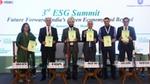
Centre for Sustainability Leadership
HUL has partnered with the Federation of Indian Chambers of Commerce and Industry (FICCI) to launch the Centre for Sustainability Leadership.
Through this, we aim to accelerate the Indian corporate sector’s climate action by institutionalising sustainability leadership across FICCI members, small and medium enterprises and micro small and medium enterprises.
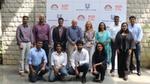
Nurturing startups working on Climate Action
HUL has partnered with IIM Bangalore’s NSRCEL, the startup hub at IIM Bangalore, to launch the Climate Incubation Hub. Through this unique collaboration between industry and academia, we aim to nurture Indian startups working on climate action and support them in accelerating the pace of transformational and scalable climate innovations.
Our Climate targets
Net Zero emissions across our value chain by 2039
Reduce absolute operational GHG emissions (Scope 1 & 2) by 100% by 2030 from a 2015 baseline
Reduce absolute Scope 3 energy and industrial GHG emissions by 42% by 2030 from a 2021 baseline
Reduce absolute Scope 3 forest, land and agriculture (FLAG) GHG emissions by 30.3% by 2030 from a 2021 baseline