
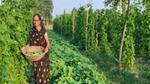
In the village of Chilbila Khattipur in Uttar Pradesh's Gonda district, farming has always been at the heart of Meera Devi's family life. Like many smallholder farmers in the region, her family cultivated paddy and wheat, relying on agriculture as their primary source of income. While these crops provided food security, the returns were often limited, and farming remained vulnerable to rising input costs, fluctuating markets, and increasing pressure on water resources.
Today, Meera's farm tells a different story. Through a combination of knowledge, collective learning, and efficient farming practices, she began to transform her land into a more productive and water-efficient enterprise, strengthening her family's livelihood while contributing to a more resilient farming system.
A new approach to farming
Through a programme supported by HUF and implemented by PANI, Meera was introduced to new farming approaches. Meera gained exposure to understand water use in agriculture, improved farming practices and enhancing productivity with resource management techniques. The exposure provided her with insights that the same amount of water can raise two crops simultaneously. She decided to allocate a portion of her land to vegetable cultivation using a machan, or trellis-based system (surface crop on ground and creeper on top), while continuing to grow traditional crops on the rest of the farm.
What seemed like a modest change at the time soon proved to be a turning point. The vegetable plot not only diversified the family's income sources but also enabled more intensive cultivation on a smaller area of land.
The power of collective learning
A key enabler in Meera's journey has been her active participation in the Mahila Kisan Sangathan, a collective of women farmers in the area.
Through regular meetings, training sessions and interactions with fellow women farmers, she gained knowledge on efficient use of water, improved cultivation practices, crop management and agricultural innovations. Just as importantly, the collective gave her the confidence to test new approaches and make informed decisions about her farm.
Women's collectives play a critical role in strengthening rural livelihoods, creating platforms for shared learning and enabling women farmers to become agents of change within their communities.
From improved incomes to greater security
The benefits of adopting improved agricultural practices extended far beyond the vegetable plot.
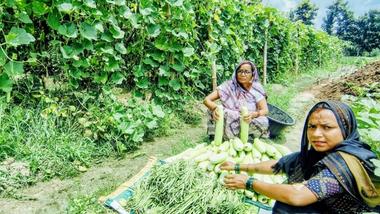
Meera Devi diversified her 3-acre farm by introducing Machan-based vegetable cultivation on 0.4 acres while continuing cereals on the remaining land. Converting the 0.4-acre plot from a traditional Paddy-Wheat system to Machan-based vegetable cultivation not only increased farm productivity but also enabled more efficient use of water, a critical consideration in a region facing increasing rainfall variability and growing pressure on water resources.
Meera’s experience demonstrates how access to knowledge and resource-efficient farming practices can set a wider cycle of progress in motion. When farmers produce more crop per drop, they not only improve farm incomes but also build greater resilience to water stress and climate uncertainty. Enhanced water productivity can translate into more stable livelihoods, stronger household assets, and increased confidence to invest in the future.
Why stories like Meera’s matter
Meera's story is personal, but the lessons extend far beyond one farm or village.
As farming communities face increasing challenges from water scarcity, climate variability, and fragmented landholdings, there is growing recognition that resilient agriculture must be built on both sustainable resource management and stronger livelihoods.
Women farmers are central to this transformation. They play a vital role in crop production, water management, household nutrition, and livelihood planning. When women farmers have access to information, institutions, and opportunities, they are often able to drive meaningful improvements in both farm productivity and natural resource stewardship.
Meera's story shows that impactful change does not always require large-scale interventions. Sometimes, it begins with a new idea, access to the right knowledge, and the confidence to try something different.
Women leading the way towards water resilience
Meera's journey is a reminder that investing in women farmers is not only about recognising their contribution to agriculture. It is about enabling them to lead the transition towards farming systems that are water-secure, productive, and climate resilient.
As more women gain access to knowledge, peer networks, and sustainable farming practices, they have the potential to drive a future where every drop of water creates greater value for farming households while safeguarding natural resources for generations to come.
Frequently asked questions
What is a machan cultivation system?
A machan is a trellis-based cultivation method where crops are grown on elevated structures. It helps optimise land use, improves crop management and support efficient irrigation practices, resulting in better water use efficiency and improved yields.
How can crop diversification benefit smallholder farmers?
Diversification helps create multiple income streams, reducing dependence on a single crop. It can improve resilience to market fluctuations, weather-related risks and crop failures while creating opportunities for higher-value produce.
How does efficient water management support livelihoods?
Efficient water use helps farmers make better use of available resources, reduce wastage and improve productivity. This can contribute to both environmental sustainability and stronger farm incomes.
Why are women's collectives important?
Women's collectives provide access to information, training and peer learning. They help women farmers build confidence, adopt improved farming practices and participate more actively in decisions that affect their livelihoods and communities.